
 By
By 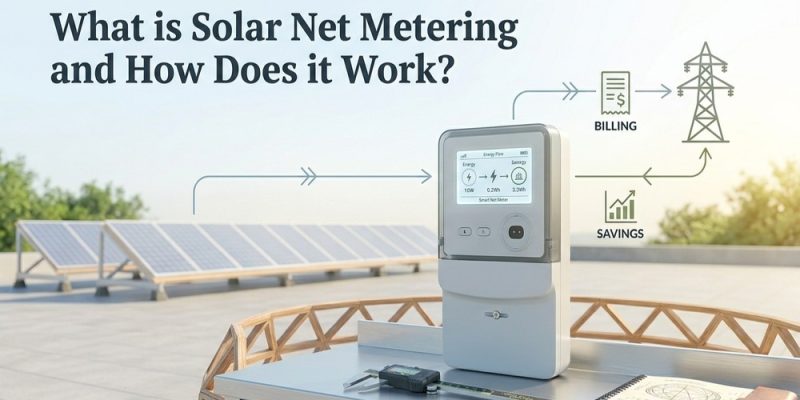
As more individuals go green, new terms have entered everyday conversation around rooftop solar. Net metering is one of them, and if you have solar panels installed on your rooftop or are considering them, it is one of the most important concepts to understand.
Solar Net Metering Explained
This refers to a billing process used by utilities in which consumers are credited for any additional amount of energy they supply to the grid. In simple terms, you will be paying for the amount of net energy that you use, which is the difference between the energy produced by your solar panels and consumed.
Net Metering in Action
During the course of a day, when your solar panels are performing at their maximum efficiency levels, you will use lesser amounts of energy compared to how much energy they produce. These extra amounts of energy are fed to the grid, and you earn credits for each unit of electricity exported. When you use more energy during nighttime or cloudy days when production by solar panels is relatively low, you can use these credits to offset energy used.
Benefits of Net Metering
Utility bill savings are the biggest advantage. A properly sized solar system can potentially eliminate your energy costs in a billing period. Payback periods are also shorter in areas offering full retail net metering, since higher bill savings mean faster recovery of installation costs. Net metering also reduces strain on the grid, as surplus solar energy from homes powers neighbouring non-solar customers, easing pressure on utility plants.
Drawbacks to Know
Net metering is not available from all electricity providers or in all locations. You need to remain grid-connected to use it, and credits are not adjusted for time-of-use in all states, meaning peak production hours may not always fetch maximum value.
Alternatives to Net Metering
If net metering is unavailable, there are other options. Net billing lets you sell unused solar energy back to your provider as a bill credit. Buy all/sell all involves purchasing all your electricity from the grid while selling all your generation separately, though typically at wholesale rates. Solar self-consumption means using only what you generate, either fully off-grid or with the grid as a backup.
Installation Process of Net Meter in India
Firstly, one should submit an application to the divisional officer. Next, an engineer from the electricity department will conduct an inspection of the site. Then, the solar power installation will take place, and finally, the net meter will be installed. The cost for installing a net meter is roughly between Rs. 10,000 and Rs. 15,000. Applications are processed quickly in states such as Gujarat and Rajasthan; it takes around 10 to 15 days.
Waaree and Net Metering
Waaree Energies is one of the most renowned suppliers of rooftop solar systems and India’s largest solar panel manufacturer, backed by a network of 600+ PAN India channel partners. Information regarding solar policy for each individual state is available on the official website of Waaree, which makes the whole process of net metering easier and ensures that you get maximum benefits from the solar power installation.












Comments